
The contents of this webpage:

 collinear with the vector
2)  ↑↑
↑↑ ↑↑
↑↑
3) =

 =
=  -
-
5) Given: the coordinate system
the vector modulus  = 5
= 5
 = 12
= 12
Find: OA
Solution:
Full solutions and text are available after subscribing to a plan.
Choose Plan***

Let  and
and  be the given vectors.
1) From the point O we draw the vectors = and  =
=
2) If ↑↓- are oppositely directed vectors, we see that the rays OA and OB form an angle  AOB
AOB
3) If ↑↑- are co-directional vectors, we see that the angle between the vectors and is equal to 0°.
The angle between two vectors and is designated as: 
Definition:
Two vectors are called perpendicular if the angle between them is 90°.
***

ABCD - is the square
AC ∩ BD = O
Find: the angles between the vectors BAC, DAB = ?
Calculation:
a) Since AC - is the diagonal of the square, we see that it divides the angle A in half. Then the angle between the vectors  = 45°
= 45°
b) Since ABCD - is a square, we see that the degree measure of the angle between the vectors  =
=  = 90°, i.e. right angle.
***

ABCD - is the rhombus
BD = AB; AC ∩ BD = 0
Compute: the angle formed by the vectors
 and
and  , and
, and  , and
, and  = ?
= ?
Solution:
Full solutions and text are available after subscribing to a plan.
Choose Plan = 0
= 0 ***


***
Given:
the triangle ΔABC is equilateral

Find: scalar product of vectors 1)  2)
2) 
Solution:
Full solutions and text are available after subscribing to a plan.
Choose Plan ; 2) -3
 ***
Given:

AB = a
the height BD
Find: scalar multiplication of vectors
1)
2)  3)
3) 
Solution:
Full solutions and text are available after subscribing to a plan.
Choose Plan ; 2) 0 ; 3)
Given:

BD ∩ AC = 0
BD = AB
1) ;
2)  ;
;
Find: the value of the angle between the vectors
1)  ; 2)
; 2) 
Solution:
Full solutions and text are available after subscribing to a plan.
Choose Plan=120°; 2) =120°. ***
Theorem:
If two vectors have coordinates {x1; y1}; { x2; y2}, then the scalar product of two vectors (formula 2) is the product of their coordinates:
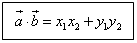
Proof:
Case 1.

Case 2.
If the vectors and - are noncollinear.
We draw the vectors from an arbitrary point O.
Consider the triangle ΔOBA.
It is known that the cosine formula
c2 = a2 + b2 - 2ab • Cos α, we obtain the equality
AB2 = OB2 + OA2 - 2 • OB • OA • Cos α (3)
Using the values (*) = ; = ; =  ; and also OA = ||; OB = || ; AB = ||, substituting the values of (*) in the equality (3), we obtain
||2 = ||2 + ||2 - 2 (4)
Using the formula to calculate the length of the vector having used its coordinates, we obtain
 =
= ;
;  =
= .
.
Since = {x2 - x1; y2 – y1}, then using the formula to calculate the distance between two points
 , we obtain
|| = 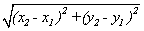 .
.
Then it follows from the equality (4) that
(x2 - x1)2 + (y2 – y1)2 = x22 + y22 + x12 + y12 - 2
x22 -2 x2 x1 + x12 + y22 – 2 y2y1 + y12 = x22 + y22 + x12 + y12 - 2
-2 x2 x1– 2 y2y1 = - 2
 = x2 x1 + y2 y1
***
Consequences:
1) If the vectors are perpendicular, i.e.
{x1; y1} { x2; y2}
  x1 x2 + y1 y2 = 0
2) By the definition of the scalar or inner product of two vectors (formula 1)
= •• Cos α
Cos α = 
The formula to calculate the cosine of the angle having used the coordinates of the vectors:
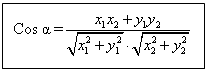
To calculate the sine and the tangent of the angle between vectors by the cosine of an angle it’s used the reduction formulas and trigonometric functions.
***
If { ; -1}; {2; 3}, then = 0.5 + (-3) = -2.5
***
If {x; -1}; {3; 2} and the vectors are perpendicular  , then = 3x - 2
  0 = 3x - 2 2 = 3x x =
***
Given:
the coordinates of the points
A(2;8), B(-1;5), C(3;1)

Solution:
Full solutions and text are available after subscribing to a plan.
Choose Plan
***
Given:
the angle between the vectors is equal to =  =60° ,
magnitudes or lengths of vectors || = 1, || = | | = 2
| = 2
Find: the product of vectors ( )= ?
)= ?
Solution:
Full solutions and text are available after subscribing to a plan.
Choose Plan)= 3 ***
Given:
= , =
, =
the magnitude or the length of the vectors | |=|
|=| |=1
|=1
- are perpendicular vectors
Find: product of vectors = ?
Solution:
Full solutions and text are available after subscribing to a plan.
Choose Plan = -5. ***
Given:
{1.5 ; 2}, {4 ; -0.5}
Find: multiplication of vectors = ?
Solution:
Full solutions and text are available after subscribing to a plan.
Choose Plan = 5. ***
Given:
{0 ; -3}, {5 ; x}
are perpendicular vectors
Find: multiplication or product of vectors = ?
Solution:
Full solutions and text are available after subscribing to a plan.
Choose Plan. ***
Given:
the coordinates of the points
A(2;8), B(-1;5), C(3;1)
Find: the cosine of the angle of vectors

2) Cos C = ?
Solution:
Full solutions and text are available after subscribing to a plan.
Choose Plan
***
Given:
 , where i and j are coordinate vectors
Find: the length or the magnitude of the vector || = ?
Solution:
Full solutions and text are available after subscribing to a plan.
Choose Plan| = 5. ***
Given:
ABCD is the rhombus
AB = , AD =

ACBD or  =0
=0
Proof:
Since the figure ABCD is the rhombus and the parallelogram, then the vectors of the parallelogram  ,
,
= -
 = (+) (-) = - 2 + 2 - = 2 -2 = =||2 -||2 = 0. Therefore, the angle between the vectors
  = 90°. Hence, the diagonals of the rhombus at the intersection point are perpendicular, i.e. ACBD.
***
Given:
the triangle ΔABC - is isosceles
AM is the median
Prove:
1) 4AM2 = AB2 + AC2 + 2AB • AC • Cos A

Proof:
1) Since the point M is the midpoint of the side BC, we see that
2 =
= 
Therefore, (2) • (2) = ()() =
= AB2 + 2AB + 2AB • AC • Cos A + AC2 = AB2 + AC2 + 2AB • AC • Cos A
We get 4AM2 = AB2 + AC2 + 2AB • AC • Cos A
2) By the formula obtained above, it follows that
4CH2 = AC2 + BC2 + 2AC • BC • Cos C
Since the triangle ΔABC is isosceles, we see that AB = BC, A = C Cos A = Cos C
We get that 4CH2 = AC2 + BC2(=AB2) + 2AC • BC(=AB) • Cos C (= Cos A)
4CH2 = AC2 + AB2 + 2AC • AB • Cos A
4CH2 = 4AM2
 =
= 
2CH = 2AM | : 2
CH = AM
***

Given:
ABCD is the convex quadrilateral
BD = d1 and AC = d2 are the diagonals
d1 ∩ d2 = O is the intersection point of the diagonals
Prove:
The area of the quadrilateral is equal to half the product of the diagonals by the sine of the acute angle between them
SABCD=  d1 • d2 • Sin α
Proof:
The area of a quadrilateral is the sum of the areas of four triangles.
SABCD= S1 + S2 + S3 + S4 , where
S1 = SΔAOB ; S2 = SΔCOB ; S3 = SΔCOD ; S4 = SΔAOD
S1 = BO • OA • Sin α
S2 = BO • OC • Sin (180° - α) = BO • OC • Sin α
S3 = CO • OD • Sin α
S4 = AO • OD • Sin (180° - α) = AO • OD • Sin α
Adding S1 + S2 + S3 + S4, we obtain
SABCD= BO • Sin α (OA+OC) +
+ OD • Sin α (CO+OA)
Since OA+OC = AC, CO+OA = AC, BO + OD = BD we see that
SABCD=BO • AC • Sin α +OD • AC • Sin α =BD • AC • Sin α
The formula of the area of a convex quadrilateral:
SABCD= d1 • d2 • Sin α
***
Given:
two vectors form an angle α = 150°,
the magnitudes or the lengths of vectors || = 2 , || = 2
 -| = ?
 Solution:
Full solutions and text are available after subscribing to a plan.
Choose Plan-| = 2
***
Given:

The angles B = 45°, C = 70°
a=24.6
Find: A - the angle in degrees, the sides b, c
Solution:
Full solutions and text are available after subscribing to a plan.
Choose PlanA = 75°; b ≈ 19.2; c ≈ 25.5. ***
Given:
the lengths of vectors || = 5, || = 8,
 =60°
=60°
Find: the value of vectors
1) ||= ?
2) | |= ?
|= ?
Solution:
Full solutions and text are available after subscribing to a plan.
Choose Plan| = ; || = 7.
 ***