
The contents of this online page:
The trigonometric ratios sine, cosine and tangent are defined as follows:
sine (sin) is opposite over hypotenuse,
cosine (cos) is adjacent over hypotenuse,
tangent (tg) is opposite over adjacent.
SOH, CAH, TOA.
Consider a right-angled triangle ΔOMD.
 ;
; 
But OM=r=1, MD=y, OD=x


Sin α = y for 0 ≤ y ≤ 1; 0 ≤ Sin α ≤ 1
Cos α=
Cos α = x for –1 ≤ x ≤ 1; –1 ≤ Cos α ≤ 1
Definition:
For any angles α (read: alpha): 0°≤ α≤180°
Sin α (the sine of α) is the ordinate of the point M,
Cos α (the cosine of α) is the abscissa of the point M.
Given:
a circle (O;r),
coordinates of points A(1;0),
B(–1;0), M1(0;1); M2( ;
; )
)

Find:
1) whether these points belong to the circle,
2) sine, cosine, tangent of angles
Solution:
Full solutions and text are available after subscribing to a plan.
Choose Plan
***
Given:
The sine of the angle: Sin α =
Find: the cosine of the alpha angle: Cos α = ?
Solution:
Full solutions and text are available after subscribing to a plan.
Choose Plan
***
Table. Trigonometric formulas of reduction. Sine, cosine in the trigonometry
| Sin (90° – α) = Cos α | Cos (90° – α) = Sin α (0°≤ α≤90°) |
| Sin (180° – α) = Sin α | Cos (180° – α) = – Cos α (0°≤ α≤180°) |
Given:
The cosine of the angle Cos α =
Find: the sine of the alpha angle Sin α = ?
Solution:
Full solutions and text are available after subscribing to a plan.
Choose Plan ***
Given:
The cosine of the angle Cos α = 
Find: the sine of the alpha angle Sin α = ?
Solution:
Full solutions and text are available after subscribing to a plan.
Choose Plan ***
Given:
The sine of the angle Sin α =
Find: the cosine of the alpha angle Cos α = ?
Solution:
Full solutions and text are available after subscribing to a plan.
Choose Plan
***
Given:
The sine of the angle Sin α =0
Find: the cosine of the alpha angle Cos α = ?
Solution:
Full solutions and text are available after subscribing to a plan.
Choose Plan***
Given:
The cosine of the angle Cos α = 1
Find: tangent of the alpha angle tg α = ?
Solution:
Full solutions and text are available after subscribing to a plan.
Choose Plan***
Given:
The cosine of the angle Cos α = 
Find: the tangent of the alpha angle tg α = ?
Solution:
Full solutions and text are available after subscribing to a plan.
Choose Plan
***
Given:
the angles  120°, 135°, 150°
Find: sine, cosine, tangent of the angles
Sin α =? Cos α = ? tg α = ?
Solution:
Full solutions and text are available after subscribing to a plan.
Choose Plan ;)
;) ***
Given:
the coordinates of the point A(2;2)
the circle of center at the origin (0;0)
Find: the angle α
Solution:
Full solutions and text are available after subscribing to a plan.
Choose Plan***
Given: the length of the segment and the angle
| 1) OA=1,5 α= 90° | 2) OA=5 α= 150° | 3) OA=2 α= 30° |
Find: the coordinates of the point A(x;y)
Solution:
Full solutions and text are available after subscribing to a plan.
Choose Plan ; 2,5) 3) (
 ;1)
;1) ***
Given:
1) A(0;3)
2) B(–;1)
Find: the angle α
Solution:
Full solutions and text are available after subscribing to a plan.
Choose Plan***
Theorem:
The area of the triangle is equal to half the product of the lengths of its two sides by the sine of the angle between them.

the triangle ΔABC
The sides of the triangle
BC=a, AC=b, AB=c
S - is the area of the triangle
Prove:
SΔABC=a • b • Sin C
Proof:
The area of the triangle is equal to half the product of the base of the triangle by its height. Therefore
SΔABC=a • h (*), where h – is the height of the triangle, a - is the base
But the height h = b • Sin C (**).
Using the condition (**) in the formula (*), then
The formula of the area of a triangle having used the sine, the base and the height
SΔABC= • a • b • Sin C
a =  ; b =
; b =
***
Given:
1) AB = 6 cm cm AC = 4 cm | 2) BC = 3 cm AB = 18 | 3) AC = 14 cm CB = 7 cm |
Find: the area of the triangle SΔ
Solution:
Full solutions and text are available after subscribing to a plan.
Choose Plan cm2 2) 27 cm2 3) 34,3 cm2
 ***
Given:
The area of the triangle SΔABC= 60 cm2
the side AC = 15 cm
the angle A = 30°
Find: the length of the side AB
Solution:
Full solutions and text are available after subscribing to a plan.
Choose Plan***
Theorem:
The area of the parallelogram is equal to the product of its two adjacent sides by the sine of the angle between them.

ABCD - is a parallelogram
AB = a
AD = b
S - is the area of the parallelogram
Prove: S = a • b • SinA = a • b • Sin α
Proof:
S = AD • BH
Consider triangles ΔABD and ΔBDC. These triangles are equal by the third theorem.
Then the areas of the triangles are also equal SΔABD = SΔBDC
SΔBDC=• BC • CD • Sin α
Then the area of the parallelogram
SABCD= SΔABD + SΔBDC= 2 • SΔBDC
SABCD=2 • • a • b • Sin α = a • b • Sin α
***
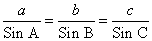
The law of sines for a triangle. Each side of an arbitrary triangle is proportional to the sine of the opposing angle.

The triangle ΔABC
AB=c, BC=a, AC=b
Prove:
Proof:
By the theorem about the area of a triangle, we obtain
SΔABC=c • b • Sin A (1)
SΔABC=a • b • Sin C (2)
SΔABC=c • a • Sin B (3)
It follows from (1) and (2) that
c • b • Sin A = a • b • Sin C
c • Sin A = a • Sin C
Then we obtain  (*)
(*)
It follows from (2) and (3) that
a • b • Sin C =c • a • Sin B
b • Sin C = c • Sin B
Then we obtain  (**)
(**)
From the equalities (*) and (**) we obtain
- is the formula of the sine of the triangle
***

Given:
the triangle ΔABC
the side AC = 12 cm
the angle A = 75°
the angle С = 60°
How to find: the side AB of the triangle, and the area of the triangle SΔABC= ?
Solution:
Full solutions and text are available after subscribing to a plan.
Choose Plan***
Given:

the side BC =  cm
cm
the angle A = 45°
the angle С = 30°
Find: the side AB of the triangle
Solution:
Full solutions and text are available after subscribing to a plan.
Choose Plan***
Given:
ABCD – is a rectangle
The diagonal AC = 10 cm
 BOC = 30°
Find: the area of a rectangle
SABCD=?
Solution:
Full solutions and text are available after subscribing to a plan.
Choose Plan***
The law of cosines for a triangle. The square of either side of the triangle is equal to the sum of the squares of the other sides and minus the doubled product of these sides by the cosine of the angle between them.
Given:

AB=c, BC=a, AC=b
Prove:
a2 = b2 + c2 - 2bc • Cos A
Proof:
Consider a rectangular coordinate system, where
1) the point A - is the origin of the coordinate plane or A(0;0)
2) the side AB lies on the abscissa, i.e. the x-axis.
Then we get B(c;0), C (b • Cos A; b • Sin A)
Using the formula to calculate the distance between two points  , we get
a2 = BC2 = (x2 - x1)2 + (y2 - y1)2 = (b • Cos A - c)2 + (b • Sin A - 0)2 =
= b2 • Cos2 A - 2bc • Cos A + c2 + b2 • Sin2 A = b2 (Cos2 A + Sin2 A) - 2bc • Cos A + c2 = b2 • 1 + c2 - 2bc • Cos A = b2 + c2 - 2bc • Cos A
Formulas of the law of cosines:

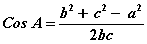
is the formula of the cosine of the triangle
***
Given:
the triangle ΔABC
the height CH = hc
the height BH1 = hb
the angle A = α
Find: the area of the triangle

Solution:
Full solutions and text are available after subscribing to a plan.
Choose Plan
is the formula how to find the area of a triangle through two heights and the sine of an angle.
***