
You will learn math problems solutions for geometry as follows:
Definition:
The position vector of an arbitrary point M is a vector connects the origin of the coordinate plane and the point M.
Theorem:
The coordinates of any  point on the coordinate plane are equal to the corresponding components of the position vector of this point.
Given:
M(x;y) is any point
 is the position vector of the point M
Prove: {x; y}
Proof:

By the parallelogram rule 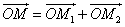 , where х=OM1

 = OM1
= OM1
 = x
= x

 = OM2
= OM2 = y
= y
So, 
Therefore {x; y}
Case 2 (Figure 2). If x<0

Formula for calculating the vector components from coordinates of the initial and terminal points of this vector.
Theorem:
Each vector component is equal to the difference of the corresponding coordinates of the initial and terminal points of this vector.

 is an arbitrary vector
A (a1;a2) are the coordinates of the initial point of the vector AB
B (b1;b2) are the coordinates of the terminal point of the vector AB
Prove: {b1 – a1; b2 – a2}
Proof:
By the triangle rule, the vector = =
=
= {b1 – a1; b2 – a2}, where  {b1;b2} and
  {a1;a2}, since they are the position vectors.
***
Given:
ΔABC is an isosceles triangle
AB=2a, CO=h
Find: the coordinates of the point A, the point B and the point C
Solution:
The point C lies on the ordinate axis, i.e., y-axis, we see that the coordinates of the point C(0;h)
Since CO is the height in the given isosceles triangle, we see that CO is the median too.
Therefore, AO=OB=2a : 2 = a
We see that the coordinates of the point A(–a;0), the coordinates of the point B(a;0), since A and B lie on the x-axis.
***
Find: components of a vector given the coordinates of endpoints of the vector
1) A(2;7) and B(–2;7); 2) A(–5;1) and B(–5;27)
Solution:
1) = B–A={–2;7}–{2;7} = {–2–2;7–7}={–4;0}
2) = {–5;27}– {–5;1} = {–5+5;27–1}={0;26}
***
Find: components of a vector given the coordinates of initial and terminal points of the vector
1) A(–3;0) and B(0;4); 2) A(0;3) and B(–4;0)
Solution:
1) = B–A= 
2) = B–A= 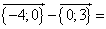

***
Find: components of a vector , and the coordinates of initial and terminal points of the vector
Solution:
1) If A(0;0), B(1;1), then = B–A= 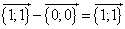
2) If A(x;–3), B(2;–7), {5;y}, then = B – A =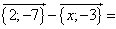

5 = 2 – x  x= –3
x= –3
y = –4
3) If A(a;b), {c;d}, we have = B – A
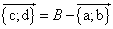 B=
B=
4) If A(1;2), {0;0}, we see that = B – A
B=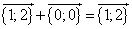
***

Given:
MNPQ is a square
P (–3;3) are the coordinates of the point
NQ ∩ PM = O(0;0)
Find: the coordinates of points M,N,Q
Solution:

Since the diagonals in the square are divided at the intersection point in half, we see that PO=OM  , since PO and OM are collinear vectors, but they are ↑↓ multidirectional vectors.
Then {3;–3} M(3;–3)
Draw a perpendicular joining the point P in the direction to the y-axis to the intersection with the diagonal NQ.
Then the point N is the vertex of the square. Since the vertex of the square is located in the first (I) coordinate quarter, we see that N(3;3); 
Since the diagonals at the intersection point are divided in half, we see that NO=OQ
 , since these vectors are collinear, but differently directed ↑↓ , i.e., they are collinear and oppositely directed vectors
Then  {–3;–3} Q(–3;–3)
Answer: M(3;–3), Q(–3;–3), N(3;3) and
M(3;–3), N(–3;–3), Q(3;3)
***
Each coordinate of the midpoint of a segment is equal to the half-sum of the corresponding coordinates of the initial and terminal points of the segment.
Given:
The segment AB, A(x1; y1), B(x2; y2)
C AB, AC=CB

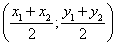
Proof:
Since the vector OC is equal to half the sum of two vectors OA and OB constructed at the same point O, we see that
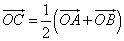
Since and are the position vectors of points A and B, we see that {x1; y1} and {x2; y2}.
Then 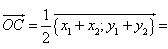
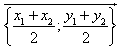
C, since  is the radius-vector of the point C.
Formula how to find the coordinates of the middle of a segment
C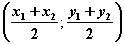
Example.
Given:
The points A and B are endpoints of the segment AB, the point M is the midpoint of the segment AB
a) Given coordinates of points A(2; –3); B(–3; 1) how to find the coordinates of the midpoint of the segment AB
Using the formula to find the coordinate of the midpoint of the segment, we get M M M
M
b) Given coordinates of points B(4; 7); M(–3; –2), then how to find the coordinates of the point A(x;y).
 and
and 
–6 = 4+x and –4 = 7+y
x= –10 and y= –11
Answer: M; A (– 10; – 11)
***
Given: vector components
 {a1; a2}
Prove that the magnitude or length of a vector is equal to the square root of sum of squares of x and y components 
Proof:
Let us draw a vector at the origin O (0;0) =
But is a position vector of the point A. Then A(a1; a2)

a1=OA1; a2=OA2=AA1
OA2=
OA=
Formula how to find the magnitude of a vector from x and y components

Example.
 {11;–11}, then
  =
= 
= 
 {10;0}, then
  =
= 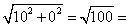 10
10
Given: the coordinates of the point
M1(x1; y1), M2(x2; y2)
Find: distance between two points
d= M1M2 = ?
Solution:
 { x2– x1; y2– y1},
 ,
,  = M1M2 = d
Then  –
–
Formula how to find the distance between two points
***
Given: coordinates of segment points: A is the initial point, B is the terminal point, M is the midpoint of a segment
| 1 | 2 | 3 | 4 | |
| A | (2;–3) | ? | (0;0) | (0;1) |
| B | (–3;1) | (4;7) | (–3;7) | ? |
| M | ? | (–3;–2) | ? | (3;–5) |
Find: coordinates of endpoints and the midpoint of the segment AB.
Solution:
Using the formula to find the coordinate of a midpoint of a segment, we obtain M
1) MM(–0,5 ; –1)
2) If B (4;7) and M (–3;–2), then we must find the coordinates of the initial point of the segment, i.e., A(x;y) – ?
–3= –6=4+x x=–10
| –2= –2•2=7+y y=– 11 |
3) M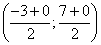 M(–1,5 ; 3,5)
4) If A (0;1) and M (3;–5), then we must find the coordinates of the terminal of the segment, i.e., B(x;y) – ?
3= 6=x+0 x=6
| –5= 2•(–5)=y+1 y=– 11 |
| 5 | 6 | 7 | 8 | |
| A | (c;d) | (3;5) | (1;3) | (3t+5;7) |
| B | ? | (3;8) | ? | (t+7;–7) |
| M | (a;b) | ? | (0;0) | ? |
5) If A (c;d) and M (a;b), then we must find the coordinates of the terminal point of the segment, i.e., B(x;y) – ?
a= 2a=c+x x=2a–c
| b= 2b=d+y y=2b–d |
6) M M(3 ; 6,5)
7) If A (1;3) and M (0;0), then we must find the coordinates of the terminal point of the segment, i.e., B(x;y) – ?
0= 0=1+x x=–1
| 0= 0=3+y y=–3 |
8) M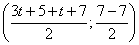 M(2t+6 ; 0)
***
Given: vector components
{5;9};  {–3;4};
  {–10;–10};
  {10;17}
Find: the magnitude of vectors  ;
;  ;
;  ;
;  – ?
– ?
Solution:
Using the formula to calculate the magnitude of a vector from x and y components,
a) = =
= =
= =
=
b) == =
= =
= =5
=5
c) =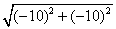 =
= =
= =10
=10
d) = =
=  =
= 
***
Given: the coordinates of points A and B
| 1 | 2 | 3 | 4 | |
| A | (2;7) | (–5;1) | (–3;0) | (0;3) |
| B | (–2;7) | (–5;–7) | (0;4) | (–4;0) |
| d | ? | ? | ? | ? |
Find: the distance between two points – ?
Solution:
Using the formula to calculate the distance between two points
 , we obtain
1) d = 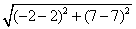 =
=  = 4
= 4
2) d = 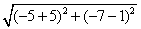 =
=  = 8
= 8
3) d = 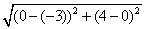 ===5
===5
4) d = 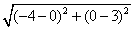 =
= ==5
==5
***

a two-dimensional coordinate grid,
a triangle ΔABC,
AM is the median
coordinates of the vertices of a triangle
A(0;1), B(1;–4), C(5;2)
Find: the length of the median AM– ?
Solution:
Using the formula to find the coordinate of the midpoint of the segment, we get M M M(3 ; –1), since the point M is the midpoint of BC
Using the formula to calculate the distance between two points
, we obtain
AM =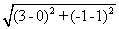 =
= =
=
Answer: AM =
***

Given:
OACB is a parallelogram
The length of side OA=a
The coordinates of the point B (b;c)
Find: the coordinates of the point C(x;y),
the length of sides AC, CO – ?
Solution:
Since the point O is the origin of the x-y coordinate plane, we see that the coordinates of the point O (0;0).
Since OA=a and the point A lies on the abscissa axis, i.e., x-axis, we see that the coordinates of the point A (a;0).
By the rule of the parallelogram and since OC is the vector, we see that
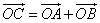
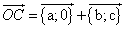 =
=
So, the vector has components {a+b;c}
Since is the position vector of the point C, we see that the coordinates of the point C (a+b;c).
Using the formula to calculate the distance between two points
, we obtain
AC = =
=
CO =  =
=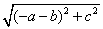 =
=
Answer: C (a+b;c) ; AC=; CO =
***

Given:
a two-dimensional coordinate plane,
a triangle  ,
,
the coordinates of the vertices of the triangle A(0;1), B(1;–4), C(5;2)
1) Prove: triangle ΔABC is isosceles
Proof:
Using the formula to calculate the distance between two points
, we obtain
AC=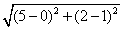 =
= =
=
AB=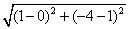 =
= =
=
Since AC=AB=, we see that triangle ΔABC is isosceles.
2) Find: SΔABC – the area of the triangle ΔABC – ?
Solution:
We draw the height AM to the base BC.
Using the formula for calculating the area of a triangle, we obtain
SΔABC= AM•BC
AM•BC
Using the formula to find the coordinate of the midpoint of the segment, we get M MM(3 ; –1), since the point M is the midpoint of BC
Using the formula to calculate the distance between two points
, we obtain
AM ===
BC =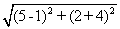 =
= =2
=2
Then the area of the triangle SΔABC =••2= =13
=13

***
Given:
the Cartesian coordinate plane,
a triangle ΔMNP,
the coordinates of vertices of a triangle
M(4;0), N(12;–2), P(5;–9)
Find: the perimeter of the triangle PΔMNP – ?
Solution:
Using the formula to calculate the distance between two points
, we obtain
MN=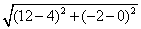 =
= =
= =
=
NP=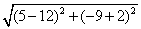 =
= =
=
PM=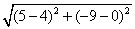 =
= =
=
Using the formula to calculate the perimeter of a triangle, we get PΔMNP =MN+NP+PM=++
Answer: PΔMNP =++
***

Given:
MNPQ is a quadrilateral
coordinates of vertices or angles of a quadrilateral are as follows
M(1;1), N(6;1), P(7;4), Q(2;4)
1) Prove: MNPQ is a parallelogram
Proof:
Using the formula to calculate the distance between two points
, we obtain
MN=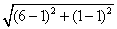 == 5
== 5
PQ =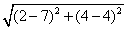 == 5
== 5
NP =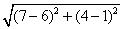 =
= =
= 
QM =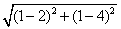 ==
==
Since MN=PQ=5 and NP=QM=, we see that MNPQ is a parallelogram
2) Find: the length of MP, NQ – ?
Solution:
Using the formula to calculate the distance between two points
, we obtain
MP =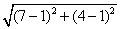 =
= =
=  =
= =3
=3
NQ =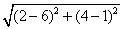 == = 5
Answer: MP= 3, NQ = 5
***
Given:
the coordinates of the points C(4;–3), D(8;1)
the point A lies on the y-axis
AC=AD
Find: the coordinates of the point A – ?
Solution:
1) Since the point A lies on the y-axis, i.e., the ordinate axis, we see that its coordinates are (0;y).
2) Using the formula to calculate the distance between two points , we obtain
AD=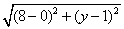 =
=
3) AC=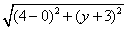 =
=
4) Since AC=AD, we see that =
64 + (y – 1)2= 16 + (3 + y)2
64 + 1 – 2y+y2=16 + 9 + 6y + y2
–2y – 6y= 25 – 65
–8y = –40
y = 5
Answer: A (0; 5).
***
Given:
O(0;0)
ΔABC is isosceles
the median OC=160cm

Find: AK; NB
Solution:
1) Since the points A and B lie on the x-axis, i.e., the abscissa axis,
we see that AO=OB=80 : 2 = 40 (cm)
The coordinates of the points B(40;0) and A(–40;0)
2) Since OC = 160 cm and the point C lies on the y-axis
The coordinates of the point C(0;160)
3) Since K is the midpoint of BC, we see that, using the formula to find the coordinate of the midpoint of the segment, we obtain K
K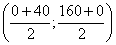 K(20 ; 80)
4) Then, using the formula to calculate the distance between two points , we obtain
AK=  =
=  =
= =100 (cm)
5) Since N is the midpoint of the segment AC, we see that, using the formula to find the coordinate of the midpoint of the segment, we obtain
N N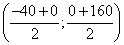 N(–20 ; 80)
6) Using the formula to calculate the distance between two points , we obtain
NB =  = ==100 (cm)
Answer: AK = NB = 100 cm
***

Given:
a triangle ΔABC
the right angle  C = 90°
The point M lies on the side AB
The point M is the midpoint of the side AB
BC=a, AC=b
Prove: the length of the height in a right angled triangle is half the length of the hypotenuse.
Proof:
Since BC=a, AC=b, we see that
the point C (0;0) – since the point C is the origin of the coordinate plane
we have B(a;0), A(0;b).
Using the formula to find the coordinate of the middle of the segment, we obtain M M M(
M( ;
; ), since the point M is the midpoint of AB.
Using the formula to calculate the distance between two points , we obtain
MC=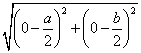 =
=  =
=
AM=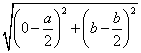 =
=
Therefore, AM=MB=MC.
***

Given:
ABCD is a parallelogram
AD=BC=a
the coordinates of points
B(b;c), D(a;0), C(a+b;c)
Prove:
The sum of squares of the sides of the parallelogram is equal to the sum of squares of diagonals of a parallelogram (where diagonals are the segments connecting the opposite vertices of the parallelogram).
AB2 + BC2 + CD2 + AD2 = AC2 + BD2
Proof:
Using the formula to calculate the distance between two points , we obtain
AB=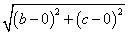 AB2 = b2+c2
AD=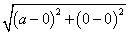 AD2 = a2
AC=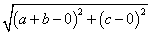 AC2 = (a+b)2 + c2
BD=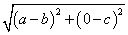 AC2 = (a–b)2 + c2
Since AB=CD, AD=BC, we see that
AB2 + AD2 + BC2 + CD2 = 2(AB2 + AD2) = 2(b2+c2 + a2)
AC2 + BD2 = (a+b)2 + c2 + (a–b)2 + c2 = a2 + 2ab + b2 + c2 + a2 – 2ab + b2 + c2 = 2(a2 + b2 + c2)
We see that AB2 + BC2 + CD2 + AD2 = AC2 + BD2
***

Definition: An equation with two variables x and y is called an equation of the line L if the coordinates of any point belonging to the line L satisfy this equation, and the coordinates of any point not lying on this line does not satisfy this equation.

Theorem - the formula of the equation of a circle or the equation of the circle radius:
On a rectangular or Cartesian coordinate system, the equation of the circle of center at the point C(x0; y0) and the radius r has the form
(x – x0)2 + (y – y0)2 = r 2
Given:
The circle (C; r) of the center at the point C,
the coordinates of the point C(x0; y0)
Prove: the equation of the circle (x – x0)2 + (y – y0)2 = r 2
Proof:
Consider a point M(x;y), lying on the circle (C;r)
Using the formula to calculate the distance between two points , we obtain
CM=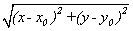 , but CM=r
Then we get CM2 = r2
r2 = (x – x0)2 + (y – y0)2 (1)
The coordinates of the point M satisfy equation (1).
If N(x1;y1) does not lie on the circle (C;r), then
Since NC ≠ r , we see that the coordinates of the point N do not satisfy equation (1).
Hence, the equation of the circle (x – x0)2 + (y – y0)2 = r 2
If the center of the circle, i.e. the point C has the coordinates C(x0; y0) = O(0;0) the equation of the circle is x2 + y2 = r 2
***
Given: the equation of a circle with the center at the point A passing through 2 points
a) x2 + y2 = 9
b) (x – 1)2 + (y + 2)2 = 4
c) (x + 5)2 + (y – 3)2 = 25
d) (x – 1)2 + y2 = 4
e) x2 + (y + 2)2 = 2
Find: the center of the circle and its radius r
Solution:
a) Let there be a circle of center A and radius r or:

circle (A;r),
and a point B with coordinates (x;y) that lies on a given circle or:
B(x;y) circle.
But AB = r, therefore, AB2=r2 r2=9 r2=32, i.e. r = 3.
Since x2 + y2 = 9, we see that x0 =0 and y0=0, and we see that the center of the circle has the coordinates A(0;0). The graph of the circle is shown in Figure a).
b) Since (x – 1)2 + (y + 2)2 = 4, we see that by the equation of the circle

x0 = 1 and y0= – 2.
Then A(1;–2), where A is the center of the circle.
Since r2 = 4, we see that r = 2. The graph of the circle is shown in Figure b)
c) Since (x + 5)2 + (y – 3)2 = 25, we see that by the equation of the circle

Then A(–5;3), where A is the center of the circle.
Since r2 = 25, we see that r = 5.
Draw this circle. The graph of the circle is shown in Figure c)
d) Since (x – 1)2 + y2 = 4, then by the equation of the circle

Then A(1;0), where A is the center of the circle.
Since r2 = 4, we see that r = 2.
Draw this circle. The graph of the circle is shown in Figure d)
e) Since x2 + (y + 2)2 = 2, we see that by the equation of the circle

Then A(0;–2), where A is the center of the circle.
Since r2 = 2, we see that r ≈ 1,4.
Draw this circle. The graph of the circle is shown in Figure e)
***
Given: the circle is given by equation
a) x2 + y2 = 25
b) (x – 1)2 + (y + 3)2 = 9
Determine: which of the points A, B, C, D, E belong to the circle (A; r),
if given are the coordinates of the points A(3;–4); B(1;0); C(0;5); D(0;0); E(0;1)
Solution:
a) If A(3;–4), where x=3 and y=–4, we see that 32 + (–4)2 = 25
9+16=25
25=25
The point A belongs to the circle (A; r) or the point A circle (A;r)
If B(1;0), where x=3 and y=0, then 12 + 02 = 25
1≠25
Therefore, the point B does not belong to the circle (A; r) or the point B  circle (A;r)
If C(0;5), where x=0 and y=5, then 02 + 52 = 25
25=25
This means that the point C belongs to the circle (A; r) or the point Ccircle (A;r)
If D(0;0), where x=0 and y=0, then 02 + 02 = 25
0≠25
This means that the point D does not belong to the circle (A; r) or the point Dcircle (A;r)
If E(0;1), where x=0 and y=1, then 02 + 12 = 25
1≠25
Hence, the point E does not belong to the circle (A; r) or the point Ecircle (A;r)
b) If A(3;–4), where x=3 and y=–4, then (3 – 1)2 + (–4 + 3)2 = 9
4+1=9
5≠9
The point A does not belong to a circle (A; r) or the point Acircle (A;r)
If B(1;0), where x=1 and y=0, then (1 – 1)2 + (0 + 3)2 = 9
9=9
The point B belongs to the circle or the point Bcircle (A;r)
If C(0;5), where x=0 and y=5, then (0 – 1)2 + (5 + 3)2 = 9
1+64≠9
65≠9
The point C does not belong to the circle (A; r) or the point Ccircle (A;r)
If D(0;0), where x=0 and y=0, then (0 – 1)2 + (0 + 3)2 = 9
10≠9
The point D does not belong to the circle (A; r) or the point Dcircle (A;r)
If E(0;1), where x=0 and y=1, then (0 – 1)2 + (1 + 3)2 = 9
17≠9
The point E does not belong to a circle (A; r) or the point Ecircle (A;r)
***
Given: the circle given by equation
The equation of a circle through 2 points (x+5)2 + (y – 1)2 = 16
The circle (C;r), where r=4, C(–5;1)
The points A(–2;4), B(–5;–3)
Determine: which of the points A or B belong to the circle (C;r)
Solution:
Using the formula to calculate the distance between two points , we obtain
CA=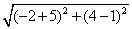 =
= =3,
=3,
3 >4, then the point A is outside the circle (C;r)
CB=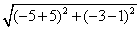 =
= =4,
=4,
4=4, then the point B lies on the circle (C;r)
***
Given:
the circle (C;r), where the diameter of the circle d=MN
the coordinates of the points M(–3;5), N(7;–3)
Write: the equation of a circle of center C passing through 2 points M and N
Solution:
Using the formula to calculate the distance between two points , we obtain
CA=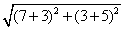 =
= =
= =2
=2 ,
,
Since d=2r, then r =• d =  =
=
Using the formula to find the coordinate of the middle of the segment, we obtain the coordinates of the center of the circle C C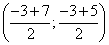 C(2;1), since the point C is the middle of MN.
Using the equation of the circle equation (x – x0)2 + (y – y0)2 = r 2, therefore, (x – 2)2 + (y – 1)2 = 
(x – 2)2 + (y – 1)2 = 41
Answer: (x – 2)2 + (y – 1)2 = 41
***
Given:
the circle (C;r), where the coordinates of the center of the circle C(0;y)
The points A and B lie on a circle
The coordinates of the points A(–3;0), B(0;9)
Write: the equation of a circle of center at the point C passing through 2 points
Solution:
Using the equation of the circle equation (x – x0)2 + (y – y0)2 = r 2, therefore, x2 + (y – y0)2 = r 2
Since the point B lies on the circle and its coordinates B(x=0;y=9).
Then the point B lies on the ordinate axis, i.e., the y-axis, then CB=r.
x2 + (y – y0)2 = r 2 02+ (9 – y0) 2 = r 2
Since the point A lies on the circle and its coordinates
A(x=–3;y=0).
Then the point A lies on the abscissa axis, i.e., the x-axis, then CB=r.
(–3)2 + (0 – y0)2 = r 2 9 + y02 = r 2
Then (9 – y0) 2 = 9 + y02
y0 2 – 18 y0 + 81 = 9 + y02
– 18 y0 = – 72
y0 = 4
Therefore, C(0;4).
We obtain the equation of a circle of the form: x2 + (y – 4)2 = r 2
Let us find the radius r.
Since the points A and B belong to the circle, then
| (–3)2 + (0 – 4)2 = r2 9+16 = r2 r2 = 25 | or | 02 + (9 – 4)2 = r2 r2 = 25
|
So we get the equation of the circle x2 + (y – 4)2 = 25
Answer: x2 + (y – 4)2 = 25
***
The graph of the equation of a straight line passing through a point. Types of equations of the line.
1) the equation of the straight line l: ax + by + c = 0, where a,b,c are the coefficients of the equation of the straight line |
2) l1: y = y0 is the equation of the straight line passing through the point M0, perpendicular to the straight line y, the y-axis, the ordinate axis, parallel to the straight line x, the x-axis, the abscissa axis |
3) l2: x = x0 is the equation of a straight line passing through the point M0, parallel to the straight axis of ordinates Oy, perpendicular to the x-axis, i.e. the axis of abscissas |
| 4) y = 0 the equation of the straight line, the x-axis, i.e., the axis of abscissas, passing through the origin point of the coordinate plane 5) x = 0 the equation of the y-axis, i.e. the ordinate axis that passes through the origin point of the coordinate plane  |
Write: the equation of a straight line passing through one point, i.e. the center of a circle.
a) (x +3)2 + (y – 2)2 = 25, parallel to the y-axis
b) (x –2)2 + (y +5)2 = 3, parallel to the x-axis
Solution:
a) (x +3)2 + (y – 2)2 = 25 the center of the circle (-3; 2), where r=5
The straight line passes parallel to the y-axis, then its equation is x=x0.
Therefore, x= –3.
b) (x – 2)2 + (y +5)2 = 3 the center of the circle (2;–5), where r=
The straight line passes parallel to the x-axis, then its equation is y=y0.
Therefore, y= –5.
***
Given: the equations of two straight lines
b1: 4x + 3y – 6=0
the straight line b2 is given by the equation: 2x + y – 4=0
Find: the coordinates A(x;y), where A is the intersection point of the straight lines b1 and b2
Solution:
We will compose and solve the system of equations of the straight lines
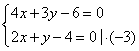
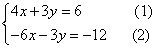
The sum of equations (1) and (2) –2x = –6
Then x=3.
We substitute x=3 in the equation 4x+3y=6.
Then 12+3y= –6 y= –2
Answer: A(3; –2)
***
Given: the coordinates of two points A(1;–1), B(–3;2)
Find the equation of the straight line AB having used the given points
Solution:
The general equation of the straight line has the form AB=ax+by+c=0, where having used the coordinates, it is necessary to find a=? b=? c=?
Since the points A and B lie on the straight line AB (or: A and B AB),
then their coordinates satisfy the equation of the straight line AB
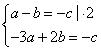
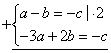
–a=–3c a=3c
Then we substitute a=3c in the equation a–b=–c. Therefore,
3c–b=–c
–b=–4c
b=4c
Then the equation of the line AB through two points: ax+by+c=0
3c+4cy+c=0
c(3x+4y+1)=0
3x+4y+1=0
Answer: the equation of a straight line having used two given points is 3x+4y+1=0
***
Given: the coordinates of two points C(2;5), D(5;2)
Solve: find the equation of the line AB passing through 2 points
Solution:
The general equation of the line AB: ax+by+c=0, where it is necessary to find a=? b=? c=?
Since the points A and B lie on the line AB, then their coordinates satisfy the equation of the line AB
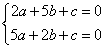
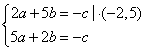
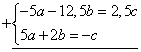
–10,5b=1,5c
c=–7b
Then in the equation 2a+5b=–c we substitute
c=–7b, then, 2a+5b=7b
2a=7b–5b
a=b
Then the equation of the line AB should be written: ax+by+c=0
bx+by+(–7b)=0
b(x + y – 7)=0
x + y – 7=0
Answer: for these two points, the equation of the line AB is x+y–7=0
***
Given:
the line AB is given by the equation 3x–4y+12=0
Find: the coordinates of two points A and B that are the points of intersection with the coordinate axes
Solution:
Since the points A and B lie on the line AB, therefore their coordinates satisfy the equation of the straight line AB.
Since the line AB intersects with the coordinate axes, then
coordinate I – (x;0)
coordinate II – (0;y)
Therefore, 3x–4•0+12=0

x=–4 A(–4;0)
3•0–4y+12=0
–4y=–12
y=3 B(0;3)
Next, we construct a straight line AB in the coordinate plane.
To construct a straight line, we first mark the points in the coordinate system: the abscissa of the point A is -4, its ordinate is zero; the abscissa of the point B is zero, its ordinate is 3. Draw a straight line through the marked two points.
Answer: A(–4;0), B(0;3)
***
Given:
Triangle ΔABC
The coordinates of the vertices of the triangle A(4;6), B(–4;0), C(–1;–4)
The point M lies on the segment AB
Solve: find the equation of a straight line containing the median MC, having used the coordinates of the points
Solution:
Let us find the coordinate of the point M.
Using the formula to find the coordinate of the middle of the segment, we obtain M M
M(0;3), since the point M is the midpoint of AB.
The canonical equation of the straight line MC passing through the point has the form: ax+by+c=0, where it is necessary to find a=? b=? c=?
Since the points M and C lie on the line MC (or: M,CMC), then their coordinates satisfy the equation of the straight line MC.
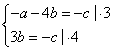
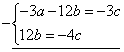
–3a=–7c
Having substituted
in the equation –a – 4b = –c, we obtain


 b=
b=
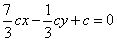
Knowing a and b, we find the coordinate equation of the straight line MC: ax+by+c=0
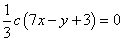
7x–y+3=0
Answer: the linear equation of the straight line MC: 7x–y+3=0
***